Understanding Bond Prices and Market Dynamics
Bond prices can be confusing for new investors. Why does a ₹1,000 face value bond trade at ₹980 or ₹1,020? Why do prices change daily? And why does the same bond show different prices on different platforms? If you're new to bonds, you may want to start with our guide on reading bond terms first. This guide explains bond pricing mechanics.
Key Takeaways
- Bond prices and interest rates move inversely — when interest rates rise, existing bond prices typically fall, and vice versa. This is the foundational principle of bond market dynamics.
- Bonds can trade at par, discount, or premium — a bond trades below face value (discount) when its coupon is lower than prevailing market rates, and above face value (premium) when its coupon is higher.
- YTM at purchase matters more than daily price swings — for investors who hold to maturity, interim price fluctuations may have little impact since the face value is returned at maturity.
- Longer-duration bonds are more sensitive to rate changes — a 1% rate increase may cause a 10-year bond to drop roughly 8.5% in price, while a 2-year bond may drop only about 1.9%.
- Price differences across platforms are typically normal — variations of ₹1–5 per ₹1,000 face value can arise from timing, lot sizes, liquidity, fee structures, and clean vs. dirty price conventions.
- Credit rating changes directly affect bond prices — an upgrade tends to push prices higher (and YTM lower), while a downgrade tends to have the opposite effect.
- Strategies like bond laddering may help manage price risk — spreading maturities across different time horizons can reduce the impact of interest rate movements on a portfolio.
The Fundamental Principle
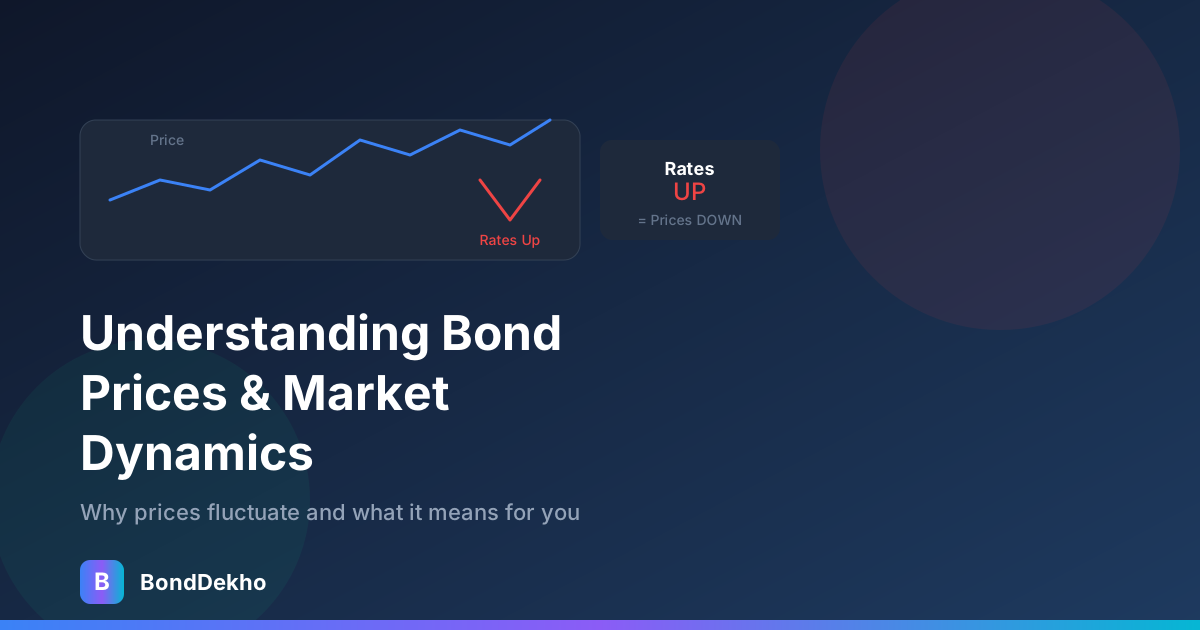
Bond prices and interest rates move inversely
When interest rates rise → Bond prices fall When interest rates fall → Bond prices rise
This inverse relationship is the foundation of bond market dynamics.
Why This Happens: A Simple Example
Imagine two scenarios:
Scenario A: You Buy Today
- You buy a bond paying 8% coupon when market rates are 8%
- You pay ₹1,000 (par value)
- You get ₹80/year in interest
Scenario B: Rates Rise Tomorrow
- Market rates rise to 10%
- New bonds are now issued at 10% coupon
- Your 8% bond becomes less attractive
- To sell, you must offer a discount
- Price might fall to ₹950 to make YTM ≈ 10%
Scenario C: Rates Fall Instead
- Market rates drop to 6%
- New bonds are issued at only 6% coupon
- Your 8% bond is now more attractive
- Buyers will pay a premium
- Price might rise to ₹1,050 to make YTM ≈ 6%
Key Pricing Concepts
1. Par, Discount, and Premium
At Par (Price = 100% of face value)
- Bond trades at face value (₹1,000 for ₹1,000 FV bond)
- Happens when coupon rate = market rate
- YTM = Coupon rate
At Discount (Price < 100%)
- Bond trades below face value (e.g., ₹980)
- Happens when coupon rate < market rate
- YTM > Coupon rate
- You get capital gain at maturity
At Premium (Price > 100%)
- Bond trades above face value (e.g., ₹1,020)
- Happens when coupon rate > market rate
- YTM < Coupon rate
- You have capital loss at maturity
2. How YTM and Price Relate
For a bond bought at:
- Discount: YTM includes interest + capital appreciation
- Par: YTM = coupon rate
- Premium: YTM includes interest - capital depreciation
Example: Bond with 9% coupon, ₹1,000 face value, 3 years to maturity
If price is ₹970:
- Annual interest: ₹90
- Capital gain at maturity: ₹30 (₹1,000 - ₹970)
- YTM ≈ 10.2% (higher than 9% coupon)
If price is ₹1,030:
- Annual interest: ₹90
- Capital loss at maturity: ₹30 (₹1,000 - ₹1,030)
- YTM ≈ 7.8% (lower than 9% coupon)
Factors Affecting Bond Prices
1. Interest Rate Changes (Primary Driver)
RBI Policy Rates:
- Repo rate increases → Bond prices typically fall
- Repo rate decreases → Bond prices typically rise
Market Sentiment:
- Expectations of rate hikes → Prices fall
- Expectations of rate cuts → Prices rise
Duration Impact:
- Longer maturity bonds are more sensitive to rate changes
- A 1% rate change impacts 10-year bond more than 2-year bond
2. Credit Rating Changes
Upgrades:
- Rating improves (e.g., A to AA)
- Perceived risk decreases
- Price typically rises
- YTM typically falls
Downgrades:
- Rating worsens (e.g., AA to A)
- Perceived risk increases
- Price typically falls
- YTM typically rises
For a deeper understanding of what each rating level means, see our credit ratings guide.
3. Time to Maturity
As bond approaches maturity:
- Price converges toward face value
- Whether it was at premium or discount
- "Pull to par" effect
Example:
- Bond bought at ₹950, face value ₹1,000
- As maturity nears, price gradually moves from ₹950 → ₹1,000
- Reverse is true if bought at premium
4. Credit Events
- Company's financial performance
- Industry developments
- Regulatory changes
- Economic conditions
Good news → Price up Bad news → Price down
5. Liquidity
More Liquid Bonds:
- Actively traded
- Tight bid-ask spread
- Prices closer to fair value
Less Liquid Bonds:
- Infrequently traded
- Wide bid-ask spread
- May trade at discount to fair value
6. Supply and Demand
- New bond issuance in same rating category
- Investors entering/exiting fixed income
- Regulatory changes (e.g., insurance companies must hold certain amount)
Why Does the Same Bond Show Different Prices on Different Platforms?
This is a common observation on BondDekho. Reasons include:
1. Timing Differences
- Prices update at different times
- Platform A shows morning price
- Platform B shows afternoon price
- Bond market price moved in between
2. Different Sellers
- Platform A: Seller willing to accept ₹990
- Platform B: Seller wants ₹1,000
- Same bond, different supply dynamics
3. Lot Sizes
- Large quantity order: Better price
- Small quantity order: Worse price
- Platforms may have different minimum lots
4. Liquidity Premium
- Platform A: Has ready buyers, tighter spread
- Platform B: Less liquidity, wider spread
5. Markup/Commission
- Different platforms have different fee structures
- Some include commission in price
- Others charge separately
6. Clean vs Dirty Price
- Clean Price: Excludes accrued interest
- Dirty Price: Includes accrued interest
- Some platforms show clean, others show dirty
This is normal. The small variations (₹1-5 per ₹1,000 FV) are typical market microstructure.
Reading Bond Listings
When you see a bond listing:
Current Price: 98.50
Face Value: ₹1,000
This means:
- Bond is trading at ₹985 per bond
- It's at discount (below ₹1,000)
- You'll get ₹1,000 at maturity
- Your YTM will be higher than coupon
Practical Implications for Investors
For Buy-and-Hold Investors
- Price fluctuations don't matter much
- You'll get face value at maturity
- Focus on YTM at purchase, not price changes
For Traders
- Price volatility creates opportunities
- Can profit from rate changes
- Need to understand duration and sensitivity
For Platform Comparison
- Compare YTM, not just price
- Small price differences are normal
- Consider transaction costs
- Check if prices are clean or dirty
Interest Rate Sensitivity (Duration)
Higher Duration = More Price Sensitive
Factors increasing duration:
- Longer time to maturity
- Lower coupon rate
Example Impact of 1% Rate Increase:
- 2-year bond: Price falls ~1.9%
- 5-year bond: Price falls ~4.5%
- 10-year bond: Price falls ~8.5%
(Actual impact depends on coupon and yield level)
When Should You Worry About Bond Price Changes?
You Should Care If:
- Planning to sell before maturity
- Using bonds for margin/collateral
- Evaluating portfolio value for reporting
You Can Ignore If:
- Holding till maturity
- Focused on steady income
- Not leveraging your bonds
At maturity, you get face value regardless of interim price movements.
Managing Price Risk
1. Laddering
- Build a bond ladder with different maturities
- Some mature every year or two
- Reduces impact of rate changes
2. Matching to Needs
- If need money in 3 years, buy 3-year bond
- Hold till maturity = no price risk
3. Stay Informed
- Monitor RBI policy announcements
- Track credit rating changes
- Be aware of issuer news
4. Focus on YTM
- YTM at purchase determines your return (if held to maturity)
- Daily price changes are noise
Common Misconceptions
"Bond price fell, I'm losing money"
- Not true if holding till maturity
- Price fluctuation ≠ actual loss
- You'll still get face value + coupons
"I should wait for lower prices"
- Timing the market is difficult
- If YTM is acceptable, price level is fair
- Lower price means higher rates, which may not happen
"Same bond, different prices means someone is cheating"
- Small differences are normal market behavior
- Reflects different supply/demand on each platform
- As long as YTM is similar, both are fair
Monitoring Your Bonds
Track these instead of daily prices:
- Issuer credit rating
- Issuer financial news
- Days to next coupon payment
- Time remaining to maturity
Use price only when:
- Comparing purchase options
- Planning to sell
- Portfolio valuation
Conclusion
Bond price movements reflect:
- Changes in interest rate environment
- Credit quality perceptions
- Market liquidity conditions
- Supply and demand dynamics
For buy-and-hold investors, interim price movements are largely irrelevant. Focus on:
- Credit quality at purchase
- YTM at purchase
- Holding till maturity
Understanding price dynamics helps you make better decisions but shouldn't cause undue anxiety about daily fluctuations. Also consider how inflation affects your real bond returns beyond just price movements.
Compare YTM across platforms on BondDekho. Use our YTM Calculator to understand price-yield relationships.
Disclaimer: This article is for educational purposes only. Bond prices fluctuate based on multiple factors. Past price movements don't predict future performance. Consult a qualified financial advisor for advice specific to your situation.