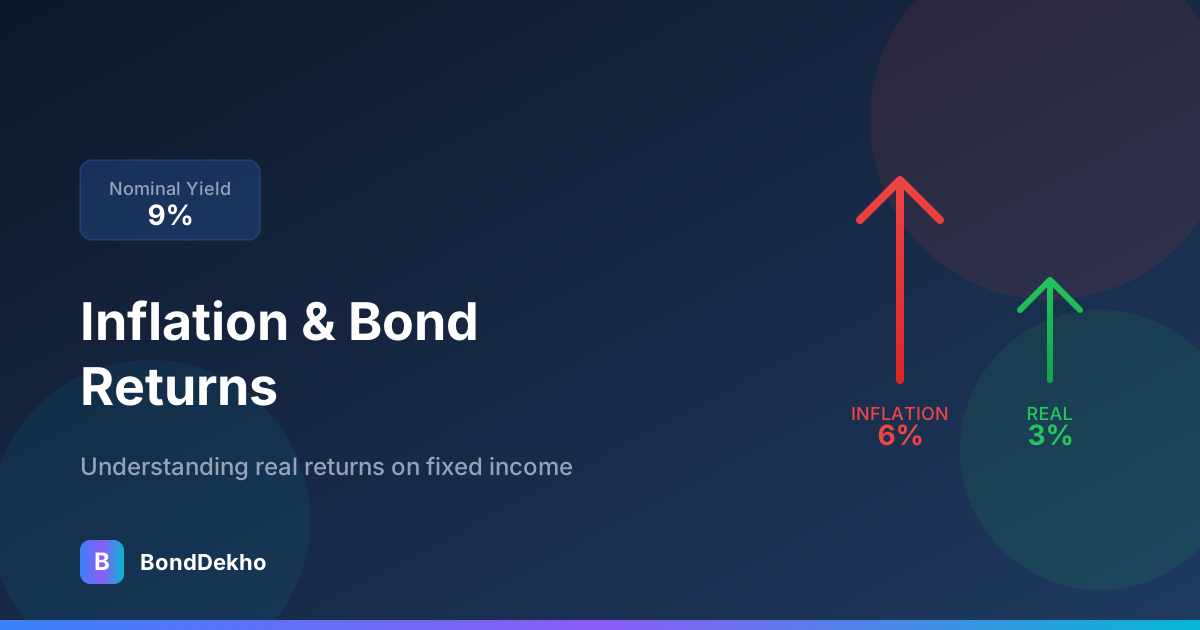
Inflation and Bond Returns: Understanding Real Returns on Fixed Income
That 9% yield on your corporate bond looks attractive on paper. But after accounting for inflation and taxes, how much are you actually earning? If you're not sure how bond yields work, start there first. This guide breaks down the concept of real returns and why every bond investor must understand inflation's impact on their portfolio.
Why Is Inflation a Problem for Bond Investors?
Unlike equity investors who can benefit from companies raising prices during inflationary periods, bond investors receive fixed coupon payments. A Rs. 80 coupon payment today buys less goods and services next year if prices rise by 6%.
What Are Nominal vs Real Returns?
Nominal Return: The stated yield or interest rate on your bond (e.g., 9% YTM)
Real Return: Your purchasing power gain after adjusting for inflation
The simplified formula:
Real Return ≈ Nominal Return - Inflation Rate
For more precision, use the Fisher equation:
Real Return = ((1 + Nominal Return) / (1 + Inflation Rate)) - 1
A Practical Example
Consider a corporate NCD with these characteristics:
- Face Value: Rs. 1,00,000
- Coupon Rate: 9% (annual)
- Maturity: 5 years
- Current Inflation: 5.5%
Nominal annual income: Rs. 9,000
Real annual income (inflation-adjusted):
Real Return = ((1.09) / (1.055)) - 1 = 3.32%
Real Income = Rs. 1,00,000 × 3.32% = Rs. 3,320
Your real purchasing power gain is only Rs. 3,320—not Rs. 9,000.
Historical Context: India's Inflation and Bond Returns
Inflation Trends (2015-2025)
| Period | Avg. CPI Inflation | Avg. 10Y G-Sec Yield | Real Return |
|---|---|---|---|
| 2015-2017 | 4.5% | 7.5% | 3.0% |
| 2018-2020 | 5.8% | 7.0% | 1.2% |
| 2020-2022 | 6.2% | 6.5% | 0.3% |
| 2022-2024 | 5.5% | 7.2% | 1.7% |
| 2024-2026 | 4.8% | 7.0% | 2.2% |
Key observation: Real returns on government bonds have historically ranged from near-zero to about 3%, averaging around 1.5-2%.
Corporate Bonds Provide Better Real Returns
Corporate bonds compensate for credit risk with higher yields:
| Bond Type | Typical Yield | Real Return (at 5% inflation) |
|---|---|---|
| G-Sec (10Y) | 7.0% | 2.0% |
| AAA Corporate | 7.8% | 2.8% |
| AA Corporate | 8.5% | 3.5% |
| A Corporate | 9.5% | 4.5% |
The credit spread provides a cushion against inflation erosion.
The Double Taxation Problem
Real returns get worse when you factor in taxes:
For Listed Bonds (Held >12 months)
- LTCG Tax: 12.5% on gains
- Effective post-tax, post-inflation return is further reduced
For Unlisted Bonds
- Interest taxed as income at your slab rate
- At 30% tax bracket, a 9% yield becomes 6.3% post-tax
- With 5% inflation, real post-tax return: only 1.3%
The Complete Picture
For a 30% tax bracket investor holding unlisted NCDs:
Nominal Yield:           9.00%
Post-Tax Yield:          6.30% (after 30% tax)
Inflation:              -5.00%
Real Post-Tax Return:    1.30%
This is why high-net-worth investors often prefer listed bonds for tax efficiency. For a complete breakdown, read our tax planning guide for bond investors.
Inflation-Protected Strategies for Bond Investors
1. Floating Rate Bonds
Floating rate bonds have coupons linked to benchmark rates (like repo rate or T-bill rates). When inflation rises, central banks typically raise rates, and your coupon adjusts accordingly.
Example: RBI Floating Rate Savings Bonds
- Interest: NSC rate + 0.35% (reset every 6 months)
- Provides natural inflation hedge
- Current rate: ~8.05%
Pros:
- Automatic rate adjustment
- Protection against rising inflation
Cons:
- Returns fall when rates decrease
- May underperform fixed-rate bonds in falling rate environment
2. Inflation-Indexed Bonds (IIBs)
RBI has issued Inflation-Indexed Bonds where:
- Principal adjusts with CPI inflation
- Coupon paid on inflation-adjusted principal
How it works:
- Face Value: Rs. 1,000
- Real Coupon: 1.5%
- If inflation is 6%, adjusted principal = Rs. 1,060
- Coupon = 1.5% × Rs. 1,060 = Rs. 15.90
These provide true inflation protection but have limited availability in India.
3. Laddering Strategy
Build a bond ladder with staggered maturities:
Year 1: 20% of portfolio matures
Year 2: 20% of portfolio matures
Year 3: 20% of portfolio matures
Year 4: 20% of portfolio matures
Year 5: 20% of portfolio matures
Benefits:
- Reinvest maturing bonds at current rates
- If inflation/rates rise, you capture higher yields on reinvestment
- Reduces timing risk
4. Shorter Duration in High Inflation
When inflation is elevated or rising:
- Prefer shorter-maturity bonds (1-3 years)
- Less price sensitivity to rate hikes
- Faster reinvestment at higher rates
When inflation is falling:
- Lock in longer-term bonds (5-10 years)
- Capture higher yields before they decline
- Benefit from price appreciation
5. Credit Spread Strategy
Higher-rated bonds have tighter spreads over government securities. In inflationary environments:
- AA/A rated bonds offer 150-250 bps spread over G-Secs (see our NCDs vs government bonds comparison)
- This spread provides inflation cushion
- But assess credit risk carefully—defaults rise in stressed economies
Real Return Benchmarks: What Should You Target?
Conservative Investors
- Target: 1-2% real return
- Strategy: High-quality AAA/AA bonds, government securities
- Priority: Capital preservation
Moderate Investors
- Target: 2-3% real return
- Strategy: Mix of AA and A-rated bonds
- Priority: Balance of safety and returns
Aggressive Fixed Income Investors
- Target: 3-4%+ real return
- Strategy: A and BBB-rated bonds, longer duration
- Priority: Maximize yield (accepting higher risk)
Warning Signs: When Inflation Erodes Your Returns
Watch for these scenarios:
1. Negative Real Returns
If your post-tax bond yield falls below inflation, you're losing purchasing power. Consider:
- Moving to higher-yielding bonds (with appropriate risk)
- Reducing bond allocation temporarily
- Adding floating rate exposure
2. Inverted Real Yield Curve
When short-term real returns exceed long-term real returns, it signals economic stress. This happened briefly in 2022.
3. Persistent High Inflation
If CPI consistently exceeds 6%, RBI typically responds with rate hikes. Existing long-term bondholders face:
- Mark-to-market losses
- Opportunity cost vs. new higher-yielding bonds
Calculating Your Portfolio's Real Return
Here's a framework to assess your bond portfolio:
Step 1: Calculate Weighted Average Yield
Portfolio Yield = Σ (Bond Yield × Weight)
Step 2: Estimate Tax Impact
Post-Tax Yield = Portfolio Yield × (1 - Tax Rate)
Step 3: Subtract Expected Inflation
Real Return = Post-Tax Yield - Expected Inflation
Example Portfolio Analysis
| Bond | Allocation | Yield | Contribution |
|---|---|---|---|
| AAA NCD | 40% | 8.0% | 3.20% |
| AA NCD | 30% | 8.8% | 2.64% |
| G-Sec Fund | 30% | 7.2% | 2.16% |
| Total | 100% | 8.00% |
Post-Tax (at 30%): 5.60%
Less Inflation (5%): 0.60%
Real Return: 0.60%
This portfolio barely beats inflation after taxes—consider adding higher-yielding options or improving tax efficiency.
Key Takeaways
-
Always think in real terms: A 9% yield means little if inflation is 7%
-
Taxes matter enormously: Unlisted bonds at high tax brackets can have near-zero real returns
-
Use floating rate bonds: As 10-20% of fixed income allocation for inflation hedge
-
Ladder your maturities: Reduces reinvestment risk and captures rate changes
-
Monitor inflation expectations: RBI's target is 4% (±2%); plan accordingly
-
Credit spreads are your friend: Higher-quality corporate bonds offer inflation cushion over G-Secs
-
Review annually: Recalculate real returns as inflation and your tax situation change
Conclusion
Bond investing isn't just about chasing the highest yield—it's about maximizing real, after-tax returns. In India's moderate inflation environment (4-6%), a well-constructed bond portfolio can deliver 2-3% real returns, which compounds meaningfully over time.
The key is understanding that your true return isn't the number on the bond certificate—it's what that money can actually buy when you need it.
Calculate real returns after inflation with our compound interest calculator. Use BondDekho to compare yields across platforms and find bonds that maximize your real returns.
Disclaimer: This article is for educational purposes only and should not be considered investment advice. Bond investments carry credit, interest rate, and liquidity risks. Please consult a SEBI-registered investment adviser before making any investment decisions. Data presented may not reflect current market conditions — verify all information independently.