NCDs vs Government Bonds: A Complete Comparison for Indian Investors
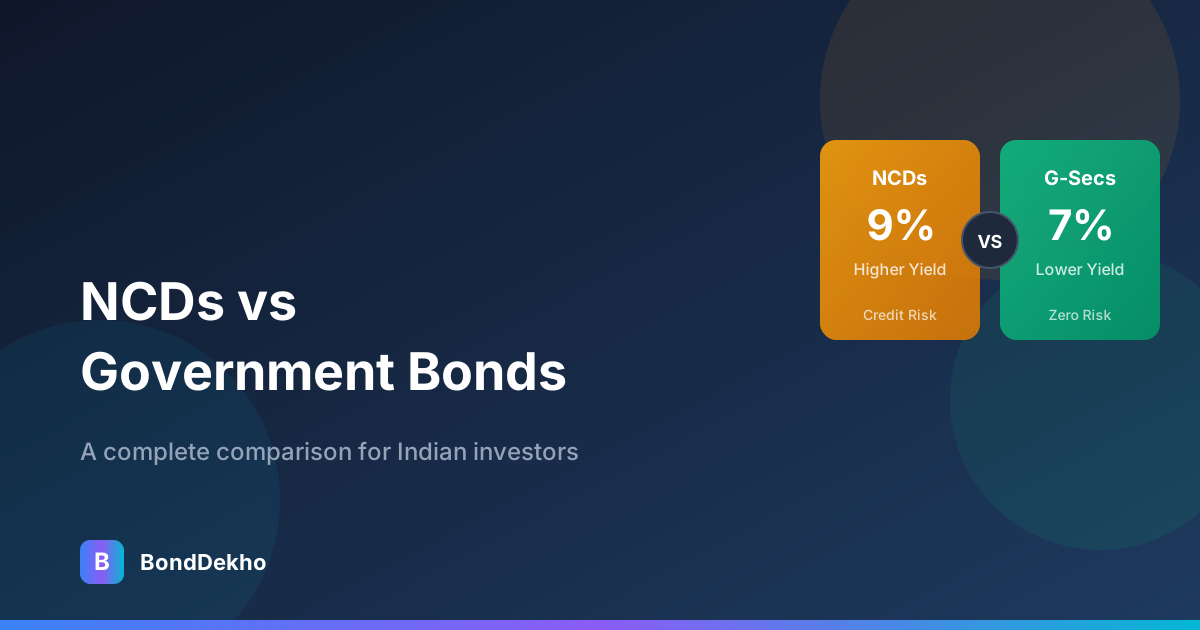
The Indian fixed income market offers two primary choices: corporate Non-Convertible Debentures (NCDs) promising 8-11% yields, and government securities (G-Secs) offering the sovereign's backing at 7-7.5%. Which is right for your portfolio? This comprehensive guide examines every dimension of this crucial investment decision.
Understanding the Instruments
Non-Convertible Debentures (NCDs)
NCDs are debt instruments issued by corporations to raise capital. "Non-convertible" means they cannot be converted to equity shares—you receive interest and principal, nothing more.
Key Characteristics:
- Issued by private and public companies
- Higher yields (8-11%+) depending on credit quality
- Credit risk exists—issuer may default
- Can be secured or unsecured (backed by assets or not)
- Traded on exchanges (listed NCDs) or held privately
Common Issuers:
- NBFCs (Bajaj Finance, Shriram Finance, Mahindra Finance)
- Infrastructure companies (L&T Finance, PFC, REC)
- Housing Finance (HDFC, LIC Housing, Can Fin Homes)
- Corporates (Tata Capital, Aditya Birla Finance)
Government Securities (G-Secs)
G-Secs are debt instruments issued by RBI on behalf of the Government of India to finance fiscal deficit.
Key Characteristics:
- Sovereign guarantee—zero credit risk
- Lower yields (6.5-7.5%) reflecting safety
- Highly liquid—active secondary market
- Interest rate sensitive—prices fluctuate with rate changes
- Various tenures: 91-day T-bills to 40-year bonds
Types of G-Secs:
- Treasury Bills (T-Bills): 91, 182, 364 days
- Dated Securities: 1-40 year bonds
- State Development Loans (SDLs): Issued by state governments
- Floating Rate Bonds (FRBs): Variable interest linked to T-bill rates
The Risk-Return Tradeoff
Yield Comparison (January 2026)
| Instrument | Typical Yield | Credit Rating | Risk Level |
|---|---|---|---|
| 91-Day T-Bill | 6.80% | Sovereign | Negligible |
| 10-Year G-Sec | 7.10% | Sovereign | Negligible |
| SDL (State Govt) | 7.35% | Sovereign | Negligible |
| AAA Corporate NCD | 7.80-8.20% | AAA | Very Low |
| AA+ Corporate NCD | 8.30-8.70% | AA+ | Low |
| AA Corporate NCD | 8.50-9.00% | AA | Low-Moderate |
| A Corporate NCD | 9.00-10.00% | A | Moderate |
| BBB Corporate NCD | 10.00-12.00%+ | BBB | High |
The Credit Spread
The difference between corporate bond yields and equivalent G-Sec yields is called the "credit spread":
Credit Spread = Corporate Bond Yield - G-Sec Yield
Current spreads in India:
- AAA over G-Sec: 70-110 bps
- AA over G-Sec: 140-190 bps
- A over G-Sec: 200-300 bps
- BBB over G-Sec: 350-500+ bps
This spread compensates investors for:
- Default risk
- Lower liquidity
- Higher volatility
Why Is Credit Risk the Critical Difference?
Government Bonds: Zero Default Risk
G-Secs carry the sovereign guarantee. The Government of India has never defaulted on domestic debt and is considered risk-free for rupee-denominated obligations.
Even State Development Loans (SDLs), while issued by state governments, implicitly carry central government backing—no state has ever defaulted.
NCDs: Credit Risk is Real
Corporate defaults do happen. Recent high-profile cases:
DHFL (2019)
- Largest NCD default in Indian history
- Rs. 84,000+ crore debt
- Retail investors lost significant capital
- Even "AA" rated at time of collapse
IL&FS (2018)
- Infrastructure financing giant
- Triggered NBFC liquidity crisis
- Multiple group companies defaulted
- Rating agencies criticized for missing early warnings
Reliance Capital (2022)
- Anil Ambani group company
- Rs. 40,000+ crore debt
- Resolution through IBC
- Investors faced significant haircuts
Understanding Default Probability
Historical default rates (CRISIL data):
| Rating | 1-Year Default Rate | 3-Year Cumulative |
|---|---|---|
| AAA | 0.00% | 0.00% |
| AA | 0.05% | 0.25% |
| A | 0.20% | 1.10% |
| BBB | 0.80% | 4.50% |
| BB | 3.50% | 15.00% |
Key insight: Even AA-rated bonds have historically defaulted. The spread over G-Secs isn't free money—it's compensation for real risk. Learn more about how agencies assess this risk in our credit ratings explained guide.
Liquidity Comparison
G-Secs: Highly Liquid
The government securities market is India's most liquid debt market:
- Daily trading volume: Rs. 30,000-50,000 crore
- Tight bid-ask spreads: 1-3 bps for benchmark securities
- Instant execution: Orders filled in seconds
- Transparent pricing: Real-time quotes on NDS-OM
You can buy/sell G-Secs through:
- RBI Retail Direct (direct access for individuals)
- Stock exchanges (NSE goBID, BSE Direct)
- Mutual funds (Gilt funds, Government securities funds)
- Banks and primary dealers
NCDs: Liquidity Varies Significantly
NCD liquidity depends on multiple factors:
Listed NCDs:
- Traded on NSE/BSE
- Liquidity varies widely by issuer
- Large issuers (Bajaj Finance, HDFC) relatively liquid
- Smaller issuers may have no buyers for weeks
- Bid-ask spreads: 20-100+ bps
Unlisted NCDs:
- No secondary market
- Must hold to maturity
- Early exit nearly impossible
- Suitable only for buy-and-hold investors
Liquidity Reality Check: If you need to sell Rs. 10 lakh of NCDs urgently:
- Bajaj Finance NCD: Likely executable, 0.3-0.5% impact
- Mid-tier NBFC NCD: May take 2-5 days, 1-2% impact
- Small issuer NCD: May be impossible at reasonable price
Interest Rate Risk
Both G-Secs and NCDs face interest rate risk—when rates rise, bond prices fall.
Duration: The Key Metric
Duration measures price sensitivity to interest rate changes:
Price Change ≈ -Duration × Interest Rate Change
Example: A bond with 5-year duration loses ~5% if rates rise 1%.
G-Secs: Higher Duration Risk
Long-term G-Secs (10Y, 20Y, 30Y) have high duration:
| G-Sec Tenure | Approximate Duration | 1% Rate Rise Impact |
|---|---|---|
| 2 Year | 1.9 years | -1.9% |
| 5 Year | 4.3 years | -4.3% |
| 10 Year | 7.5 years | -7.5% |
| 30 Year | 15.0 years | -15.0% |
In 2022, when RBI hiked rates by 2.5%, long-term G-Sec holders saw 15-25% mark-to-market losses.
NCDs: Typically Lower Duration
Most NCDs have shorter maturities (2-5 years), resulting in lower interest rate risk:
| NCD Tenure | Approximate Duration | 1% Rate Rise Impact |
|---|---|---|
| 2 Year | 1.8 years | -1.8% |
| 3 Year | 2.7 years | -2.7% |
| 5 Year | 4.2 years | -4.2% |
However: Some NCDs have call options allowing issuers to redeem early if rates fall—you may not capture the full benefit of falling rates.
How Are NCDs and Government Bonds Taxed Differently?
Tax treatment significantly impacts net returns. For comprehensive strategies, see our tax planning guide for bond investors.
Listed Bonds (NCDs and G-Secs on exchanges)
Held > 12 months (LTCG):
- Tax rate: 12.5% on capital gains
- No indexation benefit (from FY 2024-25)
- Coupon interest taxed at slab rate
Held < 12 months (STCG):
- Taxed at your income tax slab rate
Unlisted NCDs
- Interest taxed as "Income from Other Sources"
- Your marginal tax rate applies (up to 30% + cess)
- Capital gains also at slab rate (no LTCG benefit)
Tax Comparison Example
Rs. 10 lakh investment, 3-year holding:
| Aspect | Listed NCD (8.5%) | G-Sec Fund (7.2%) | Unlisted NCD (9%) |
|---|---|---|---|
| Annual Return | Rs. 85,000 | Rs. 72,000 | Rs. 90,000 |
| 3-Year Total | Rs. 2,55,000 | Rs. 2,16,000 | Rs. 2,70,000 |
| Tax (30% slab) | ~Rs. 31,875* | ~Rs. 27,000* | Rs. 81,000 |
| Net Return | Rs. 2,23,125 | Rs. 1,89,000 | Rs. 1,89,000 |
*Listed bonds: LTCG at 12.5% on gains portion
Key insight: Unlisted NCDs lose their yield advantage after taxes for high-income investors.
When to Choose Government Bonds
Ideal Scenarios for G-Secs
-
Capital Preservation is Priority
- Retirement corpus
- Emergency fund component
- Goal-based investing (child's education)
-
You Need Liquidity
- May need to exit before maturity
- Want flexibility to rebalance
-
Interest Rate View: Rates Will Fall
- Lock in current rates
- Benefit from price appreciation
- Long-duration G-Secs can deliver equity-like returns
-
Portfolio Hedge
- G-Secs rally when equity markets crash
- Negative correlation provides diversification
-
Tax-Advantaged Accounts
- NPS (government bond allocation)
- PPF (invests in G-Secs)
How to Invest in G-Secs
Direct Investment:
- RBI Retail Direct: Minimum Rs. 10,000
- NSE goBID / BSE Direct: Buy listed G-Secs
- Suitable for: Investors who understand bond pricing
Through Mutual Funds:
- Gilt Funds: Pure G-Sec exposure
- Government Securities Funds: Mix of G-Secs and SDLs
- Target Maturity Funds: Hold specific G-Secs to maturity
- Suitable for: Most retail investors
When to Choose NCDs
Ideal Scenarios for NCDs
-
Higher Yield is Essential
- Regular income needs (retirees)
- Willing to accept credit risk for 100-200 bps extra
-
Buy-and-Hold Strategy
- Will hold to maturity
- Don't need liquidity
- Can do credit due diligence
-
Tax-Efficient Options Available
- Listed NCDs for LTCG benefit
- Lower tax brackets
-
Secured NCDs Available
- Asset-backed NCDs reduce default risk
- Recovery possible even if issuer struggles
-
Strong Issuer Selection Skills
- Can analyze balance sheets
- Monitor credit developments
- Exit if warning signs appear
NCD Selection Framework
Must-Have Criteria:
- Minimum AA rating from 2 agencies
- Secured by tangible assets
- Listed on exchanges
- Issuer track record > 10 years
- Debt-to-equity < 6x (for NBFCs)
Red Flags to Avoid:
- Rating downgrades in last 2 years
- Promoter pledging shares
- Related-party transactions
- Aggressive growth with weak capital
- Concentration in risky segments
Building a Balanced Allocation
Conservative Portfolio (Low Risk)
| Asset | Allocation | Expected Yield |
|---|---|---|
| G-Secs / Gilt Funds | 50% | 7.0% |
| AAA NCDs | 30% | 7.8% |
| SDLs | 20% | 7.3% |
| Weighted Average | 100% | 7.3% |
Balanced Portfolio (Moderate Risk)
| Asset | Allocation | Expected Yield |
|---|---|---|
| G-Secs / Gilt Funds | 30% | 7.0% |
| AAA NCDs | 30% | 7.8% |
| AA NCDs | 30% | 8.5% |
| SDLs | 10% | 7.3% |
| Weighted Average | 100% | 7.7% |
Growth Portfolio (Higher Risk)
| Asset | Allocation | Expected Yield |
|---|---|---|
| G-Secs | 20% | 7.0% |
| AA NCDs | 40% | 8.5% |
| A NCDs | 30% | 9.5% |
| AAA NCDs | 10% | 7.8% |
| Weighted Average | 100% | 8.5% |
The Verdict: It's Not Either/Or
The G-Sec vs NCD decision isn't binary. Most investors benefit from holding both:
G-Secs Provide:
- Safety anchor for portfolio
- Liquidity for rebalancing
- Crisis hedge (rally during equity selloffs)
- Rate view expression
NCDs Provide:
- Yield enhancement (100-200+ bps)
- Regular income for cash flow needs
- Diversification across issuers
- Tax efficiency (if listed)
Suggested Allocation by Risk Profile
| Risk Profile | G-Secs | AAA NCDs | AA/A NCDs |
|---|---|---|---|
| Conservative | 70% | 30% | 0% |
| Moderate | 40% | 35% | 25% |
| Aggressive | 20% | 30% | 50% |
Key Takeaways
-
G-Secs are truly risk-free for credit; NCDs are not—even AAA can face stress
-
Yield spread is compensation for real default risk, not free alpha
-
Liquidity matters: G-Secs trade easily; many NCDs are illiquid
-
Tax efficiency favors listed bonds for high-income investors
-
Duration risk applies to both: Long-term bonds of any type lose value when rates rise
-
Diversification is key: Hold both G-Secs and NCDs across ratings and issuers
-
Do your homework on NCDs: Rating isn't everything—analyze the issuer
-
Match to your needs: Income needs → NCDs; Capital preservation → G-Secs
Conclusion
Government bonds offer unmatched safety and liquidity at the cost of lower yields. Corporate NCDs offer higher returns but require careful issuer selection and tolerance for credit risk.
The optimal strategy for most investors is a blend: use G-Secs as your safe foundation and add carefully selected NCDs for yield enhancement. A bond ladder strategy can help you structure this mix across different maturities. The exact mix depends on your risk tolerance, income needs, and ability to analyze credit.
Remember: in fixed income, there are no free lunches. The extra yield on NCDs exists because there's extra risk—make sure you're being compensated adequately for the risks you take.
Compare NCDs across all platforms on BondDekho to find the best risk-adjusted yields. Use our YTM Calculator to evaluate price-yield tradeoffs.
Disclaimer: This article is for educational purposes only and should not be considered investment advice. Bond investments carry credit, interest rate, and liquidity risks. Please consult a SEBI-registered investment adviser before making any investment decisions. Data presented may not reflect current market conditions — verify all information independently.