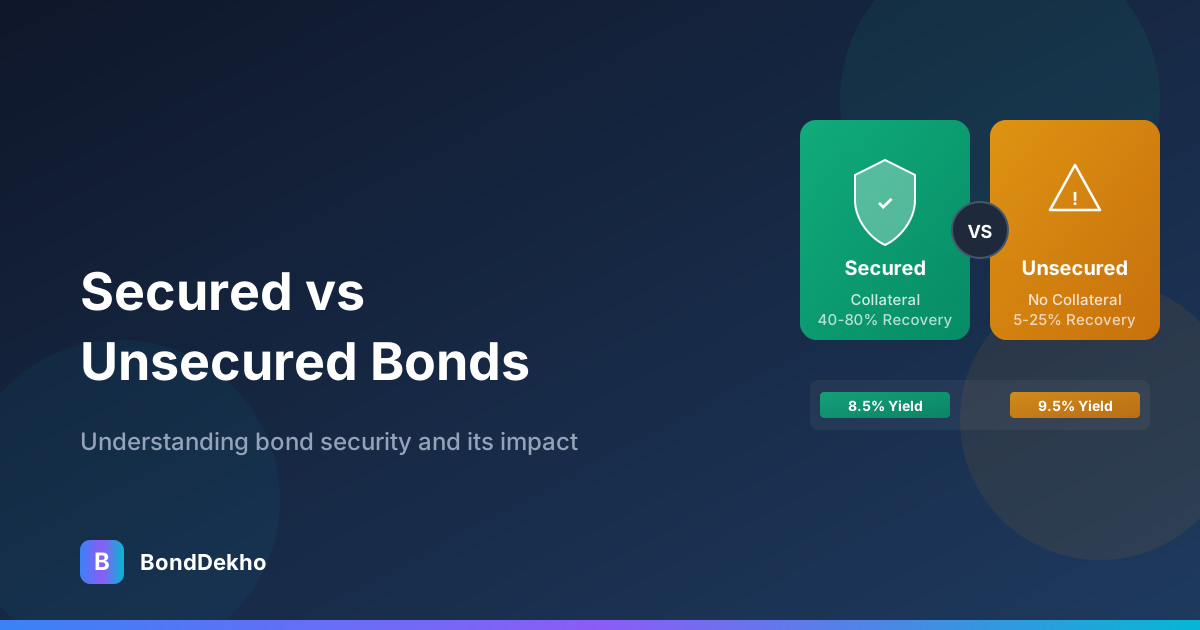
Secured vs Unsecured Bonds: What Every Investor Must Know
When browsing bonds on any platform, you'll notice some marked "Secured" and others "Unsecured." This single label can mean the difference between recovering your money if things go wrong—or losing it entirely. If you're new to bond terminology, our guide to reading bond terms covers the basics. Yet most retail investors don't fully understand what bond security means or how it should influence their decisions.
What Makes a Bond "Secured"?
A secured bond is backed by specific assets pledged as collateral. If the issuer defaults (fails to pay interest or repay principal), bondholders have a legal claim on those assets.
Types of Collateral
| Collateral Type | Example | Common In |
|---|---|---|
| Real Estate | Factory, office building, land | Manufacturing, Infrastructure |
| Receivables | Future loan repayments, tolls | NBFCs, Infrastructure |
| Fixed Deposits | FDs held in escrow | Various |
| Plant & Equipment | Machinery, vehicles | Manufacturing |
| Inventory | Raw materials, finished goods | Trading companies |
| Financial Assets | Shares, mutual fund units | Financial services |
How Does Bond Security Work in Practice?
When a company issues a secured NCD, it typically:
- Pledges specific assets worth 1x-1.25x the bond issue value
- Appoints a debenture trustee (required by SEBI) to monitor collateral
- Creates a charge on the assets registered with the Ministry of Corporate Affairs (MCA)
- Maintains asset cover ratio as specified in the offer document
If the company defaults:
Default → Debenture Trustee steps in → Assets sold → Bondholders repaid
The key word is "first claim"—secured bondholders are paid before unsecured creditors, equity shareholders, and most other claimants. For a detailed look at the full default and recovery process, see our guide on bond defaults and warning signs.
What Makes a Bond "Unsecured"?
An unsecured bond (or debenture) has no specific collateral backing. Your investment relies entirely on:
- The issuer's ability to generate cash flows
- The issuer's overall financial health
- The issuer's willingness to honour obligations
If the issuer defaults on an unsecured bond, you join a queue of creditors. Your recovery depends on whatever assets remain after secured creditors are paid first.
What Happens When a Bond Issuer Defaults?
If a company goes bankrupt, here's the legal order of repayment under the Insolvency and Bankruptcy Code (IBC):
| Priority | Claim Type | Typical Recovery |
|---|---|---|
| 1 | Insolvency resolution costs | ~100% |
| 2 | Secured creditors (including secured bondholders) | 40-80% |
| 3 | Employee dues (24 months) | Variable |
| 4 | Unsecured creditors (including unsecured bondholders) | 5-25% |
| 5 | Government dues | Low |
| 6 | Equity shareholders | Usually 0% |
The gap between secured recovery (40-80%) and unsecured recovery (5-25%) is enormous.
Secured vs Unsecured: Side-by-Side Comparison
| Factor | Secured Bonds | Unsecured Bonds |
|---|---|---|
| Collateral | Yes (specific assets pledged) | None |
| Typical Yield | Lower (by 0.5-1.5%) | Higher (risk premium) |
| Recovery in Default | 40-80% (first claim on assets) | 5-25% (subordinate claim) |
| Credit Rating Impact | Often rated 1 notch higher | Lower for same issuer |
| Trustee Monitoring | Active (SEBI-mandated) | Limited |
| Common Issuers | NBFCs, Infrastructure, PSUs | Tech companies, Startups, NBFCs |
| Investor Suitability | Conservative to moderate | Moderate to aggressive |
| Minimum Investment | Usually Rs. 10,000-1,00,000 | Usually Rs. 10,000-1,00,000 |
How Does Security Affect Credit Ratings?
Rating agencies explicitly consider bond security when assigning ratings. For a full breakdown of what each grade means, see our credit ratings explained guide. The same company can have different ratings for its secured and unsecured instruments:
Real-World Rating Differences
| Issuer | Secured NCD Rating | Unsecured NCD Rating | Difference |
|---|---|---|---|
| Typical AAA NBFC | AAA | AA+ | 1 notch |
| Large AA+ Corporate | AA+ | AA | 1 notch |
| Mid-size AA Company | AA | AA- or A+ | 1-2 notches |
| Smaller A-rated Firm | A+ | A or A- | 1-2 notches |
A notch difference might seem minor, but it significantly affects:
- Default probability: AA has ~0.05% 1-year default rate vs A+ at ~0.1%
- Recovery rate: Higher security = higher recovery if default occurs
- Pricing: Institutional investors demand higher yields for lower ratings
How Much Extra Yield Do Unsecured Bonds Offer?
The yield spread between secured and unsecured bonds from the same issuer typically ranges from 0.5% to 1.5%.
Yield Comparison (Indicative)
| Issuer Rating | Secured NCD Yield | Unsecured NCD Yield | Spread |
|---|---|---|---|
| AAA | 7.5-8.0% | 8.0-8.5% | 0.5% |
| AA+ | 8.0-8.5% | 8.5-9.2% | 0.5-0.7% |
| AA | 8.5-9.0% | 9.2-10.0% | 0.7-1.0% |
| A+ | 9.5-10.5% | 10.5-12.0% | 1.0-1.5% |
Is the Extra Yield Worth the Risk?
Let's calculate. Suppose you invest Rs. 5,00,000:
Option A: Secured AA+ NCD at 8.5%
- Annual income: Rs. 42,500
- Expected loss (0.03% default probability × 40% loss given default): Rs. 60
- Risk-adjusted income: Rs. 42,440
Option B: Unsecured AA NCD at 9.5%
- Annual income: Rs. 47,500
- Expected loss (0.05% default probability × 80% loss given default): Rs. 200
- Risk-adjusted income: Rs. 47,300
Extra risk-adjusted income from unsecured: Rs. 4,860/year. On Rs. 5 lakhs, that's meaningful over a 3-5 year holding period. But the calculation changes dramatically for lower-rated issuers.
For A-rated issuers:
Option C: Secured A+ NCD at 10%
- Expected loss: Rs. 5,00,000 × 0.1% × 50% = Rs. 250
- Risk-adjusted income: Rs. 49,750
Option D: Unsecured A NCD at 11.5%
- Expected loss: Rs. 5,00,000 × 0.2% × 85% = Rs. 850
- Risk-adjusted income: Rs. 56,650
The extra yield looks attractive, but remember: if that one default hits, your loss is not Rs. 850—it's Rs. 4,25,000 (85% of principal). Expected value and actual outcomes are very different things.
When Should You Choose Secured Bonds?
Choose Secured When:
- Capital preservation is priority: You can't afford to lose principal
- Investing a large sum: Concentration risk is high
- Issuer is mid-rated (A/BBB): Security provides critical safety net
- You're investing for a specific goal: Education, home purchase, retirement
- Your portfolio lacks diversification: Fewer than 5 bond positions
A Rule of Thumb
For your overall bond portfolio:
70-80% in Secured bonds → Stable foundation
20-30% in Unsecured bonds → Yield enhancement
When Might Unsecured Bonds Be Acceptable?
Unsecured Can Work When:
- Issuer is AAA-rated: Top-quality companies rarely default, and even unsecured debt has strong implicit backing
- You're diversified: Small allocation across multiple unsecured bonds limits any single default's impact
- The yield pickup is meaningful: At least 0.75-1% above secured alternatives
- Short maturity: Less time for things to go wrong
- Strong cash flow visibility: The issuer has predictable, recurring revenues
The "AAA Unsecured" Exception
Unsecured NCDs from AAA-rated issuers like HDFC, Bajaj Finance, or LIC Housing are widely held by institutional investors. Their balance sheets are strong enough that collateral is almost redundant. For these names, the higher yield of unsecured bonds can make sense.
How to Check If a Bond Is Secured?
What to Look For
- Platform listing: Most OBPPs clearly label "Secured" or "Unsecured"
- Offer document: The Information Memorandum (IM) details security type and collateral
- Credit rating report: Mentions "secured" in the instrument name
- BondDekho listing: Security type is shown on the bond detail page
Red Flags in Secured Bonds
Not all "secured" bonds are equally safe. Watch for:
| Red Flag | What It Means |
|---|---|
| Asset cover ratio < 1x | Collateral doesn't fully cover the bond value |
| Second charge | Another lender has first claim on the same assets |
| Intangible collateral | Brand value, goodwill—hard to liquidate |
| Related party collateral | Assets from group companies (may be encumbered) |
| No independent valuation | Collateral value not verified by third party |
| Declining asset values | Real estate in falling markets, depreciating equipment |
What "Asset Cover Ratio" Means
The asset cover ratio tells you how much collateral backs each rupee of debt:
Asset Cover Ratio = Value of Pledged Assets / Outstanding Bond Value
| Ratio | Safety Level |
|---|---|
| > 1.5x | Strong (Rs. 1.50 of collateral per Rs. 1 of debt) |
| 1.25x | Adequate |
| 1.0x | Minimum (barely covered) |
| < 1.0x | Inadequate (you're partially unsecured) |
SEBI mandates a minimum asset cover of 1x for secured NCDs, but higher is always better.
Historical Default Data: Why It Matters
CRISIL Default Study (India, 2015-2024)
| Rating | 3-Year Default Rate | Avg Recovery (Secured) | Avg Recovery (Unsecured) |
|---|---|---|---|
| AAA | 0.00% | N/A | N/A |
| AA | 0.15% | 65% | 20% |
| A | 0.80% | 55% | 15% |
| BBB | 3.50% | 40% | 8% |
| BB | 12.00% | 25% | 3% |
Two critical takeaways:
- Default rates jump dramatically below AA
- Recovery rates for unsecured bonds are 3-4x lower than secured
Building a Portfolio with Both
Conservative Portfolio (Rs. 10 Lakhs)
| Allocation | Type | Rating | Yield | Amount |
|---|---|---|---|---|
| 40% | Secured NCD | AAA | 7.8% | Rs. 4,00,000 |
| 30% | Secured NCD | AA+ | 8.5% | Rs. 3,00,000 |
| 20% | Unsecured NCD | AAA | 8.3% | Rs. 2,00,000 |
| 10% | Unsecured NCD | AA+ | 9.2% | Rs. 1,00,000 |
| Blended | 8.25% | Rs. 10,00,000 |
This portfolio is 70% secured, 70% AAA/AA+ rated—offering safety with a meaningful yield pickup from the unsecured allocation.
Aggressive Portfolio (Rs. 10 Lakhs)
| Allocation | Type | Rating | Yield | Amount |
|---|---|---|---|---|
| 30% | Secured NCD | AA+ | 8.5% | Rs. 3,00,000 |
| 25% | Secured NCD | AA | 9.0% | Rs. 2,50,000 |
| 25% | Unsecured NCD | AA | 9.8% | Rs. 2,50,000 |
| 20% | Unsecured NCD | A+ | 10.5% | Rs. 2,00,000 |
| Blended | 9.35% | Rs. 10,00,000 |
Higher yield, but 45% unsecured exposure and A+ rated bonds require careful issuer selection and monitoring.
Key Takeaways
-
Secured bonds have collateral backing; unsecured bonds rely only on the issuer's creditworthiness
-
Recovery in default differs massively: 40-80% for secured vs 5-25% for unsecured
-
Unsecured bonds pay 0.5-1.5% higher yield as compensation for the extra risk
-
For AAA issuers, unsecured bonds are generally acceptable—the issuer's balance sheet is the real security
-
Below AA rating, always prefer secured bonds—the recovery gap becomes critical if anything goes wrong
-
Check the asset cover ratio: 1.25x or above means adequate collateral backing
-
Diversify across both types: A 70/30 secured-to-unsecured split works well for most investors
Conclusion
The secured vs unsecured distinction isn't just a label—it's a fundamental risk factor that determines what happens to your money if things go wrong. While defaults are rare for investment-grade issuers, the consequences are severe enough that every investor should understand this difference before buying.
The smart approach: use secured bonds as your portfolio's foundation for safety, and selectively add unsecured bonds from strong issuers for yield enhancement. A bond ladder can help you diversify across both types with staggered maturities. Don't chase yield without understanding what you're giving up in exchange.
Use BondDekho to compare secured and unsecured bonds across platforms and find the right balance for your portfolio.
Disclaimer: This article is for educational purposes only and should not be considered investment advice. Bond investments carry credit, interest rate, and liquidity risks. Please consult a SEBI-registered investment adviser before making any investment decisions. Data presented may not reflect current market conditions — verify all information independently.