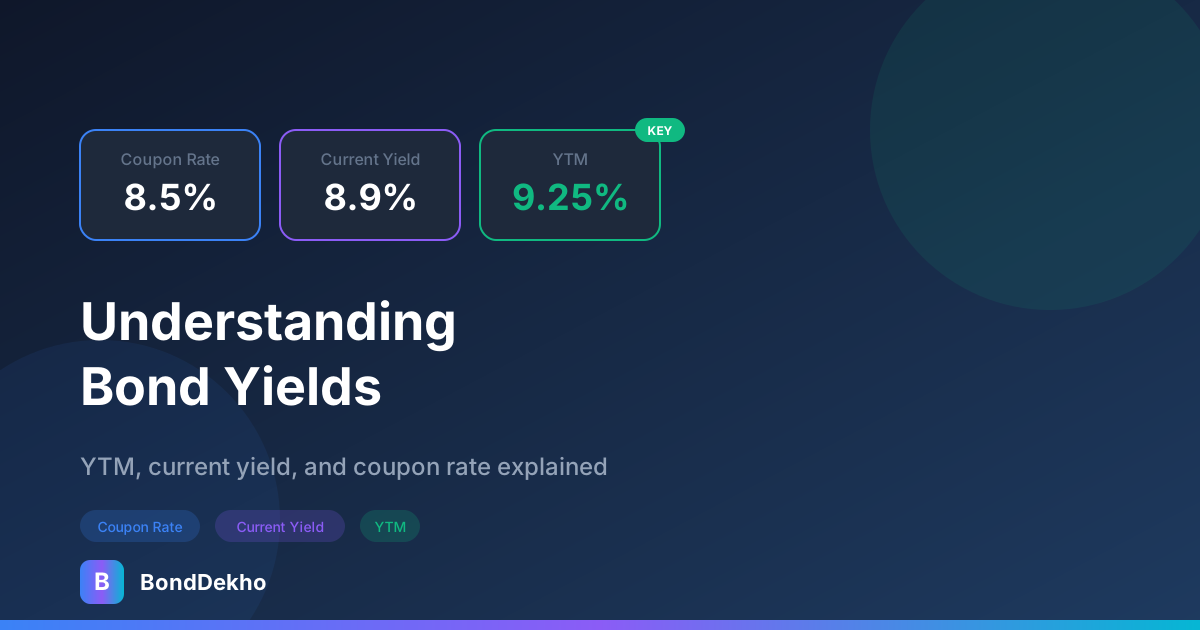
Understanding Bond Yields
When investing in bonds, understanding yields is crucial for making informed decisions. Yield tells you what return a bond may deliver — but there are several types of yield, and each answers a different question. This guide walks you through the key concepts every bond investor should know, with practical examples using Indian corporate bonds.
Key Takeaways
- YTM is the most comprehensive yield measure — it accounts for coupon payments, price gains/losses, and time to maturity, making it the standard for comparing bonds
- Current yield only tells part of the story — it ignores capital gains or losses at maturity, so two bonds with the same current yield can have very different total returns
- Higher yields typically mean higher risk — a bond offering 12% YTM when similar-rated bonds offer 9% may signal hidden credit concerns
- Credit rating is the primary yield driver — AAA bonds typically yield 1-3% less than A-rated bonds as compensation for the difference in default risk
- The same bond can show different YTMs across platforms — differences in pricing, timing, and lot sizes create yield variations of 0.1-0.5%
- Tax treatment significantly affects real returns — a 10% YTM bond may deliver only 7-8% after tax depending on your income bracket and holding period
- Always compare YTM, not coupon rate — a bond with a 7% coupon trading at a discount can deliver a higher YTM than one with a 10% coupon trading at a premium
What is Yield to Maturity (YTM)?
Yield to Maturity (YTM) is the total annualized return you can expect if you hold a bond until it matures. It takes into account:
- The bond's current market price
- Its face value (par value)
- The coupon rate (annual interest)
- Time remaining until maturity
- Frequency of coupon payments
The YTM Formula
While the exact calculation requires iteration, the approximate YTM formula is:
Approximate YTM = [C + (F - P) / n] / [(F + P) / 2]

Where:
C = Annual coupon payment
F = Face value
P = Current market price
n = Years to maturity
A Practical Example
Consider a bond with these characteristics:
- Face Value: ₹1,000
- Coupon Rate: 9% (₹90 per year)
- Current Price: ₹950
- Maturity: 3 years
Approximate YTM = [90 + (1000 - 950) / 3] / [(1000 + 950) / 2]
                = [90 + 16.67] / [975]
                = 106.67 / 975
                = 10.94%
Even though the coupon rate is 9%, the YTM is approximately 10.94% because you're buying the bond at a discount (₹950) and will receive ₹1,000 at maturity — that ₹50 capital gain boosts your effective return.
You can use our YTM Calculator to compute exact YTM for any bond, and learn more about bond terminology in our guide on how to read bond terms.
Why YTM Matters
YTM allows you to compare bonds with different coupon rates, prices, and maturities on an equal footing. Without YTM, it's difficult to tell whether a 10% coupon bond at ₹1,050 is a better deal than an 8% coupon bond at ₹920. YTM normalizes these differences into a single comparable number.
What Is the Difference Between Current Yield and YTM?
Current Yield is simpler to calculate:
Current Yield = Annual Coupon Payment / Current Market Price
Using the example above: Current Yield = ₹90 / ₹950 = 9.47%
However, current yield doesn't account for:
- Capital gains or losses at maturity
- Reinvestment of coupon payments
- Time value of money
That's why YTM is generally more useful for comparison.
Yield Types Compared
| Yield Type | What It Measures | Accounts for Price? | Accounts for Maturity? | Use Case |
|---|---|---|---|---|
| Coupon Rate | Stated interest rate | No | No | Understanding annual interest payments |
| Current Yield | Income relative to price | Yes | No | Quick income comparison |
| YTM | Total return if held to maturity | Yes | Yes | Comparing bonds (most used) |
| Yield to Call | Return if issuer calls early | Yes | Yes (to call date) | Evaluating callable bonds |
| Post-Tax Yield | After-tax return | Yes | Yes | Comparing real returns across tax brackets |
When Does Current Yield Equal YTM?
When a bond trades at exactly its face value (par), the current yield and YTM are identical, and both equal the coupon rate. As soon as the price moves above or below par, they diverge.
| Scenario | Price vs Face Value | Current Yield vs YTM |
|---|---|---|
| Premium bond | Price > Face Value | Current Yield < YTM < Coupon Rate |
| Par bond | Price = Face Value | Current Yield = YTM = Coupon Rate |
| Discount bond | Price < Face Value | Current Yield > Coupon Rate, YTM > Current Yield |
What Factors Affect Bond Yields?
1. Credit Rating
Higher-rated bonds (AAA, AA) typically offer lower yields because they're considered safer. Lower-rated bonds compensate for higher risk with higher yields. This difference is called the credit spread.
| Rating Category | Typical YTM Range | Credit Spread Over AAA | Default Probability (5-year) |
|---|---|---|---|
| AAA | 7.5–8.5% | Base rate | Near zero |
| AA+ to AA- | 8.5–10.0% | +0.5–1.5% | Very low |
| A+ to A- | 10.0–12.0% | +2.0–3.5% | Low to moderate |
| BBB+ to BBB- | 12.0–14.0% | +4.0–5.5% | Moderate |
Note: Ranges are indicative and vary with market conditions. Data is for educational reference only.
For a deeper dive into what each rating means, see our guide to credit ratings.
2. Interest Rates
When RBI raises the repo rate, newly issued bonds offer higher coupons, making existing lower-coupon bonds less attractive. Their prices fall, and their yields rise. This inverse relationship between price and yield is fundamental to bond investing.
Example: If the RBI raises rates by 0.5%, a bond with 5 years to maturity might see its price drop by approximately 2-2.5%, causing its YTM to rise correspondingly.
This relationship is explored in detail in our article on bond prices and market dynamics.
3. Time to Maturity
Generally, longer-maturity bonds offer higher yields to compensate for the additional risk of holding the bond longer. This is because:
- More time means more uncertainty about the issuer's financial health
- Interest rate risk increases with longer duration
- Your money is locked in for a longer period (liquidity risk)
A typical yield curve slopes upward — 1-year bonds yield less than 3-year bonds, which yield less than 5-year bonds.
4. Market Conditions
Supply and demand for bonds, economic outlook, and inflation expectations all influence yields:
- High inflation expectations push yields up, as investors demand compensation for purchasing power erosion. See our detailed analysis of inflation and bond returns.
- Flight to safety during economic uncertainty pushes high-rated bond yields down as demand increases
- New issuances flooding the market can push yields up temporarily
5. Secured vs Unsecured
Secured bonds, backed by collateral, typically offer lower yields than unsecured bonds from the same issuer. The yield difference reflects the additional protection investors receive. Learn more about this distinction in our guide on secured vs unsecured bonds.
How Should You Compare Bond Yields Across Platforms?
When comparing bonds on BondDekho, consider these factors:
- YTM across platforms — The same bond may show different yields on different platforms due to pricing differences, timing, and lot sizes
- Credit rating — Compare YTM within the same rating category for a fair comparison
- Maturity date — Match to your investment horizon for meaningful comparisons
- Minimum investment — Ensure it fits your budget
- Post-tax yield — A bond's attractiveness changes based on your tax bracket
Why Does the Same Bond Show Different YTMs?
It's common to see the same ISIN with slightly different YTMs across platforms. This happens because:
| Reason | Typical Impact |
|---|---|
| Different purchase prices | 0.1–0.3% YTM difference |
| Price update timing | 0.05–0.2% YTM difference |
| Different lot sizes available | May affect pricing |
| Platform-specific markups | 0.1–0.5% YTM difference |
| Clean vs dirty price display | Can appear as a difference but isn't |
This is why BondDekho aggregates pricing from 9+ platforms — to help you see the full picture in one place.
How Do Taxes Affect Your Bond Yield?
Bond returns are taxable, and the tax impact can significantly reduce your effective yield. Our detailed guide on tax planning for bond investors covers strategies for maximizing post-tax returns.
Tax Treatment Summary
| Income Type | Holding Period | Tax Rate |
|---|---|---|
| Interest income (coupons) | Any | As per your income slab (0-30%) |
| Capital gains — listed bonds | < 12 months | As per income slab |
| Capital gains — listed bonds | > 12 months | 12.5% LTCG |
| Capital gains — unlisted bonds | < 24 months | As per income slab |
| Capital gains — unlisted bonds | > 24 months | As per income slab |
Post-Tax Yield Example
A bond with 10% YTM delivers different real returns depending on your tax bracket:
| Tax Bracket | Approximate Post-Tax Yield | Effective Return on ₹1 Lakh |
|---|---|---|
| 0% (no tax) | ~10.0% | ₹10,000 |
| 5% | ~9.5% | ₹9,500 |
| 20% | ~8.0% | ₹8,000 |
| 30% | ~7.0% | ₹7,000 |
Simplified illustration. Actual post-tax yield depends on the split between interest income and capital gains. Use our Tax Calculator to estimate your post-tax returns.
What Are Common Misconceptions About Bond Yields?
"Higher coupon rate means higher return"
Not necessarily. A bond with a 10% coupon trading at ₹1,100 (premium) may have a lower YTM than a bond with a 7% coupon trading at ₹850 (deep discount). Always compare YTM, not coupon rate.
"YTM is guaranteed"
YTM assumes you hold to maturity AND that coupon payments are reinvested at the same rate. In practice, reinvestment rates may differ. For bonds held to maturity, the more significant risk is issuer default, not reinvestment.
"The highest-yielding bond is always the most attractive"
An unusually high yield relative to peers with similar ratings often signals higher risk that the market has already priced in. If an A-rated bond yields 14% when similar A-rated bonds yield 10%, it may indicate concerns about the issuer's creditworthiness. Understand the risk-return tradeoff before committing.
"All yield comparisons are equal"
Make sure you're comparing like with like — same credit rating tier, similar maturity, same tax treatment. Comparing a 3-year AAA bond's yield with a 7-year BBB bond's yield isn't meaningful.
Conclusion
Understanding yields is the first step to informed bond investing. Always compare YTM across platforms, consider the credit risk, factor in taxes, and match maturities to your investment horizon. The yield number alone doesn't tell the full story — it needs to be evaluated alongside the bond's rating, security type, and your own financial situation.
Start comparing bonds on BondDekho to see yields across 9+ platforms side by side.
Disclaimer: This article is for educational purposes only and should not be considered investment advice. Bond investments carry credit, interest rate, and liquidity risks. Please consult a SEBI-registered investment adviser before making any investment decisions. Data presented may not reflect current market conditions — verify all information independently.